
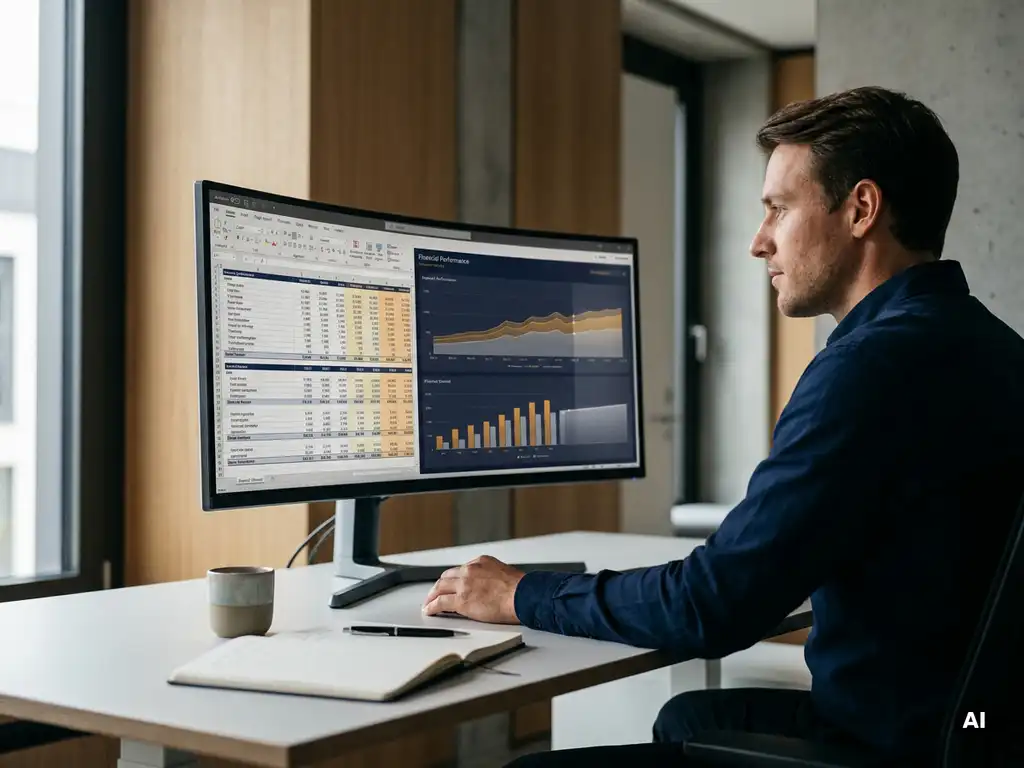
CPM software, short for Corporate Performance Management software, is a specialised software category that helps businesses combine their financial planning, consolidation, reporting and analysis into an integrated system. It is primarily aimed at medium-sized and large enterprises with complex group structures that want to base their corporate management on a sound, data-driven foundation. The following sections answer the most important questions about CPM platforms, their use and their implementation.
What core functions does CPM software have?
A CPM software combines the four core functional areas of financial planning, consolidation, reporting and analysis into a single platform. It replaces fragmented spreadsheets and siloed solutions with an integrated system that brings together all relevant financial data from various sources and keeps it consistent.
Specifically, powerful corporate performance management software typically covers the following core areas:
- Financial planning and budgeting: Creation and management of budgets, forecasts and medium-term planning at group level, including scenario comparisons and simulations.
- Consolidation: Automated group consolidation according to HGB, IFRS or local standards, including intercompany elimination and currency translation.
- Reporting and dashboards: Flexible reports and interactive dashboards that display financial metrics in real time and can be individually tailored for various recipients.
- Data integration: Seamless integration with ERP systems, HR systems and other data sources, resulting in a consistent, audit-proof database.
- Workflow and process control: Automated closing processes, approval workflows and audit trails that reduce manual intervention and ensure compliance.
The key advantage over stand-alone solutions lies in end-to-end data consistency: all users work from the same database, which minimises the effort required for data reconciliation and noticeably improves the quality of corporate management.
What exactly do companies use CPM software for?
Companies use CPM software specifically to automate monthly, quarterly and annual financial statements, to digitise budgeting and forecasting processes, and to produce management reports. The practical benefits are particularly evident in areas where manual processes, scattered Excel files and a lack of data transparency have previously hampered efficiency.
In practice, the most common use cases can be divided into three categories:
Financial statement preparation and consolidation processes
Groups with multiple subsidiaries use CPM platforms to automate intercompany reconciliations, carry out consolidation entries based on rules, and produce financial statements significantly faster. What used to take weeks can be reduced to just a few days with a well-designed CPM solution.
Planning, budgeting and forecasting
Financial planning software enables centralised management of company-wide planning processes. Various scenarios, rolling forecasts and bottom-up plans from individual business units can be consolidated and reconciled directly with the budget. This speeds up decision-making cycles and significantly improves the accuracy of planning.
What is the difference between CPM, ERP and BI software?
The key difference lies in the focus: ERP software manages operational business processes and transaction data; BI software analyses and visualises historical data; whilst CPM software is specifically geared towards financial management, planning and consolidation. CPM combines elements from both worlds, but goes beyond their respective purposes.
In practical terms, this means:
- ERP systems Systems such as SAP or Oracle record transactions, purchase orders and stock movements. They provide the raw data, but are not designed for group-wide planning or consolidation.
- BI tools Tools such as Power BI or Tableau visualise and analyse this data. They are powerful in terms of presentation, but do not usually offer native planning or consolidation functions.
- CPM software accesses ERP data, processes it for planning and consolidation purposes, and presents the results in structured reports. It acts as the link between the operational data foundation and strategic corporate management.
In practice, all three types of system are often run in parallel. The CPM platform acts as a central „single point of truth“ for all financial management information, whilst ERP and BI bring their respective strengths to bear in data generation and visualisation.
For which businesses is CPM software worthwhile?
CPM software is particularly beneficial for medium-sized and large companies with multi-tiered corporate structures, international subsidiaries or complex planning and financial reporting processes. The greater the number of entities subject to consolidation and the more labour-intensive the manual financial processes, the greater the benefits of a specialised solution.
Specific characteristics that indicate a high level of need:
- Several companies or segments that need to be consolidated
- Month-end closings that take several weeks to complete due to manual reconciliations
- Planning processes that are coordinated across numerous versions of Excel and email threads
- Reporting requirements under IFRS, the German Commercial Code (HGB) or other standards involving a significant compliance burden
- Increasing demands for transparency, scenario analysis and real-time reporting
In terms of sectors, companies in manufacturing, retail, insurance and capital market-related sectors benefit particularly from professional consolidation software, as regulatory requirements and the complexity of group structures are especially high in these areas. Companies that still rely entirely on Excel-based processes often underestimate the effort involved as the organisation grows.
How does the implementation of CPM software work?
The implementation of CPM software typically follows a structured phased approach, ranging from requirements analysis through design, implementation and training to live operation. Careful preparation is crucial, as the software must be closely integrated with existing ERP systems, chart of accounts and processes.
A proven approach is broken down into the following steps:
- Needs analysis: Identifying the technical requirements relating to controlling, accounting and management. Which processes need to be mapped? Which data sources need to be integrated?
- Concept and timetable: Development of a clear implementation plan with defined milestones, responsibilities and resources.
- Technical adjustment: Configuration and customisation of the CPM platform to suit the company’s specific business processes, chart of accounts and reporting structures.
- Training and knowledge transfer: Training users in finance and controlling departments so that they can operate and further develop the system independently.
- Production and Support: Supporting the first financial years and ensuring the continuous optimisation and further development of the solution.
Experience shows that the critical success factors are meticulous master data management, close involvement of the business departments from the very beginning, and an experienced implementation partner who understands both the functional and technical requirements. More on Services relating to CPM implementations shows the corresponding service portfolio.
Which CPM software solutions are on the market?
The market for corporate performance management software comprises a range of established platforms that differ in terms of functional scope, integration capabilities, and target audience. Among the best-known solutions are CCH Tagetik, IBM Planning Analytics (TM1), SAP BPC, Oracle EPM, LucaNet, and OneStream.
An overview of the main platforms:
- CCH Tagetik: A comprehensive CPM platform with particularly strong capabilities in consolidation, planning and compliance reporting. Especially suited to corporate groups with high regulatory requirements and a need for integrated end-to-end processes.
- IBM Planning Analytics (TM1): Known for its high flexibility in data modelling and its performance with complex, multi-dimensional planning models.
- SAP BPC Particularly widespread in SAP-heavy system landscapes, it offers tight integration into existing SAP environments.
- LucaNet Particularly well established in the German-speaking Mittelstand, with a strong focus on group consolidation and financial reporting under HGB and IFRS.
- Oracle EPM: A cloud-native solution with a broad range of functions, predominantly used in international corporations with Oracle infrastructure.
Choosing the right CPM software depends on the existing system landscape, the requirements for consolidation and planning, the size of the company and the available budget. An independent comparison of the platforms as part of an evaluation is recommended before a decision is made.
How Gramke Consulting assists with the implementation of CPM software
Gramke Consulting supports medium-sized and large enterprises in the selection, implementation and optimisation of CPM software with a clear focus on CCH Tagetik. As a certified CCH Tagetik partner, the company combines deep expertise in group accounting, controlling and planning with technical implementation strength to develop tailored solutions that deliver measurable results.
Specifically, the range of services includes:
- Analysis and evaluation of suitable CPM platforms based on individual requirements
- End-to-end implementation of CCH Tagetik for consolidation, planning, forecasting and reporting
- Integration of existing ERP systems (SAP, Oracle, MS Dynamics, etc.) and further data sources
- Process optimisation for month-end, quarter-end and year-end financial statements
- Training, coaching and long-term support following implementation
- Complementary Power BI solutions for interactive management reporting
Reference customers such as Talanx AG demonstrate expertise in handling complex corporate structures and demanding financial processes. Anyone looking to put their corporate management on a stable, scalable basis can directly book a consultation appointment and discuss your individual requirements.
Related Articles
- How long does the onboarding of new employees take in CCH Tagetik?
- How can CCH Tagetik be implemented without data loss?
- How can we accelerate our consolidated financial statements with CCH Tagetik?
- What differentiates CPM software from traditional ERP software?
- What are the advantages of CCH Tagetik compared to other CPM solutions?
 Deutsch
  English (UK)
  Čeština